

Port Aransas Water Color & Water Quality Today
Forecast for Saturday, October 24, 2026
A modeled read on today's Gulf water clarity at Mustang Island — built from real-time NOAA buoy, National Weather Service, and USGS river data — plus the official Texas Beach Watch bacteria readings.
Calm inputs across the board — typical clear-to-green Gulf water expected.
Confidence: mediumUpdated Sat, Oct 24, 1:41 PM CDT Inputs are pulled fresh and re-scored about once an hour whenever someone loads this page.
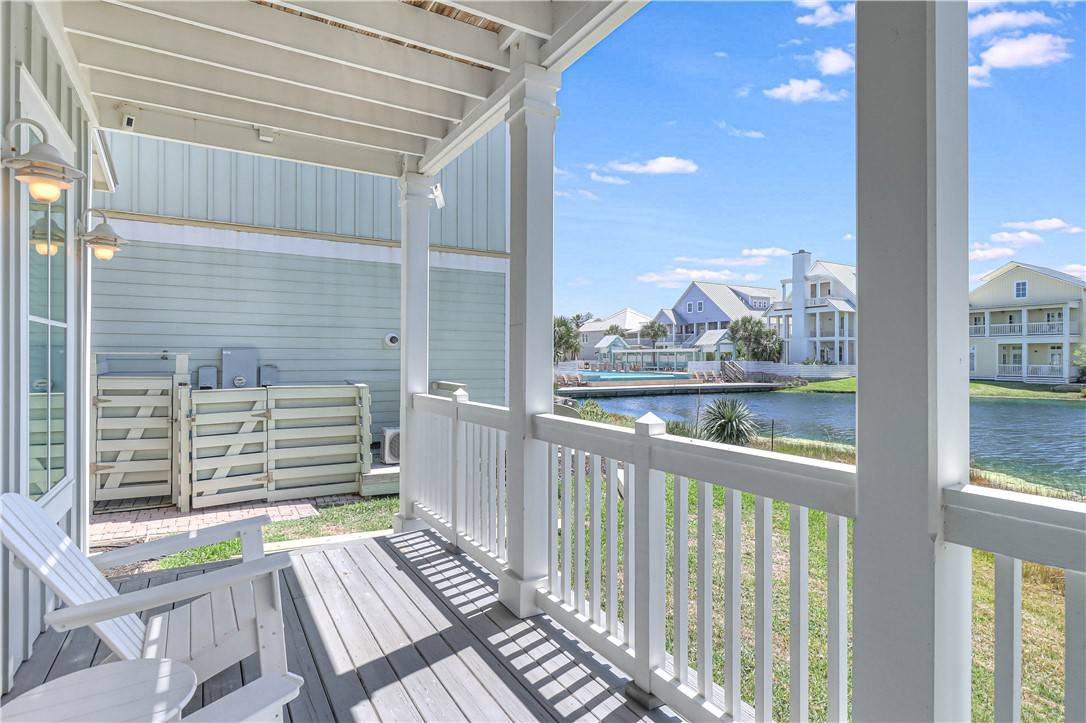
Gulf water changes day to day; community pools are a good backup plan. Beached Inn is a 3-bedroom Cinnamon Shore home that sleeps 10, with a private elevator, a covered porch, and community pools and beach boardwalk access.
- 3 bedrooms, sleeps 10
- Private elevator
- Covered porch
- Community pools
- Beach boardwalk access
Today's verdict is a model, not an official reading.
No agency publishes a daily water-color reading for Port Aransas. We combine four public, real-time inputs — wave height, recent rainfall, river discharge, and onshore wind — into a transparent score. Each factor and its contribution are shown below. A score of 0–1 reads as "likely clear," 2–4 as "mixed," and 5 or more as "likely murky." The score re-runs about once an hour against the latest NOAA, NWS, and USGS feeds — matching how often those agencies publish new observations.
- Surf (NDBC buoy 42020) — +0 Buoy data unavailable
- Rainfall, last 72 hr (NWS KRAS) 0.46 in +1 Light recent rain — minor runoff influence.
- River discharge (USGS, combined) 59 cfs +0 Rivers at typical baseflow — negligible plume influence on the Gulf.
- Onshore wind (NWS Port A) 9 mph onshore +0 Onshore but light — limited effect on dispersion.
Where the data comes from
Map: OpenStreetMap contributors. Marker: Port Aransas. The Mustang Island Gulf-facing beach runs the full length of the island from the south jetty down to Mustang Island State Park.
See it yourself — live UTMSI cameras
Two live cameras on the UTMSI pier at the north end of Mustang Island show today's actual Gulf and harbor water in real time. If the modeled verdict above says "murky" and the camera shows turquoise water, trust your eyes.
Looking east out the Aransas Pass ship channel toward the Gulf. Best single shot of nearshore water color today. Hosted by WebCOOS.
Looking west into the Port Aransas harbor and Lydia Ann Channel. Useful for comparing harbor chop to open-Gulf conditions. Hosted by WebCOOS.
There's also a third nearby camera on the lifeguarded swimming beach: Horace Caldwell Pier.
Cross-check with measured turbidity (FNU)
The University of Texas Marine Science Institute (UTMSI) runs continuous turbidity sensors on the Mission–Aransas National Estuarine Research Reserve. Turbidity is reported in FNU (Formazin Nephelometric Units) — the higher the number, the cloudier the water.
We don't republish those readings here, because the official feed (NOAA's CDMO) is gated to allowlisted IPs and we'd rather send you to the current graph than risk a stale number. The ranges below are a plain-English rule of thumb we use to picture what a given FNU value looks like on Mustang Island — they aren't an official scientific threshold; the authoritative number is whatever the CDMO graph shows right now:
| FNU range | What it looks like | Context |
|---|---|---|
| < 5 FNU | Crystal clear / turquoise today | Open-Gulf clarity — bottom visible in the wash, glassy green-blue tone. |
| 5–15 FNU | Good visibility, slightly greenish | Typical fair-weather Texas Gulf — green-blue with some fine suspended sediment. |
| 15–30 FNU | Murky / brown — typical after wind or rain | What you'd expect after onshore breeze ≥ 15 mph or a few tenths of an inch of recent rain. |
| ≥ 30 FNU | Very stirred up | Strong wave or runoff event — water reads tan to chocolate, visibility under a foot. |
Open the live graph: CDMO Data Graphing & Export — pick reserve "Mission–Aransas (MAR)" and parameter "Turb".
Why the Gulf turns dark sometimes
The water at Port Aransas is naturally a warm green-blue most of the year. When it looks brown, gray, or stained, the cause is almost always one (or a combination) of the following:
- Wave-stirred sand. The Texas Gulf shelf is shallow and sandy. When surf builds above ~3 ft, wave action lifts bottom sediment into the surf zone and the water looks tan even on a sunny day. This is the most common cause and clears within hours of the surf laying back down.
- Local runoff after rain. Rain that falls on Mustang Island, the ship channel, and the bay side drains across roads, dunes, and beach creeks into the surf zone. Tannins (from inland organic matter) and fine clay particles tint the water tea-brown along the wash for a day or two after a heavy storm.
- Freshwater river plumes. The Mission, Aransas, and Nueces rivers all empty into the bay and estuary system behind Mustang Island. When these rivers are running high after upstream Texas rain, the freshwater plume eventually exits to the Gulf through Aransas Pass and can darken the nearshore water for several miles.
- Seasonal phytoplankton. In warm months a healthy bloom of microscopic algae can tint the water cloudy green or even slightly red. Most blooms are harmless and short-lived; the rare harmful algal bloom (red tide, Karenia brevis) is monitored by Texas Parks & Wildlife and posted on the beach when it happens.
- Sargassum and seaweed. Late spring through summer, rafts of pelagic Sargassum drift ashore. Fresh, golden mats are part of a healthy Gulf ecosystem. When they pile up and decompose, the water near the wrack line can look darker and tea-stained for a few feet out. For the full picture, see our guide to seaweed season in Port Aransas.
None of these conditions makes the beach unsafe on their own. For safety, defer to the on-beach Port Aransas Beach Patrol flag and the bacteria readings linked below.
Beach bacteria levels
The Texas Beach Watch program (Texas General Land Office, with sampling support from Texas A&M Corpus Christi) tests Mustang Island swimming beaches for Enterococcus bacteria — the EPA's standard indicator of recent fecal contamination in marine water. Samples are typically taken weekly during the recreation season (April–October) and less frequently in the cooler months. A swim advisory is posted when a sample reads above 104 CFU per 100 mL, the threshold set by 30 TAC §307.7.
We don't re-publish those readings here, because the data isn't available as a public feed and we'd rather link you to the official source than risk showing a stale or wrong number. Click any station below to open its current readings on the Texas Beach Watch dashboard:
- Port Aransas Beach — IB Magee Beach Park. North end of Mustang Island, near the south jetty
- Port Aransas Beach — Horace Caldwell Pier. Lifeguarded swimming beach in central Port Aransas
- Mustang Island — Beach Access Road 1A. South of Port Aransas city limits
- Mustang Island — Mustang Island State Park. Mustang Island State Park beach, ~14 mi south of Port A
One-tap shortcut: Open the Texas Beach Watch dashboard for Mustang Island →
Historical water clarity
A daily record of this page's modeled clarity verdict—not a measured turbidity or swimming-safety reading. Collection began September 5, 2026, so earlier months are not backfilled with guesses.
| Month | Observed | Clear | Mixed | Murky |
|---|---|---|---|---|
| October 2026 | 24 | 19 | 5 | 0 |
| September 2026 | 26 | 26 | 0 | 0 |
What tends to accompany murky days
We need at least 14 observed days, including multiple murky days, before reporting patterns. This avoids calling a short weather swing a trend.
Frequently asked questions
How is today's Port Aransas water color calculated?
We model the verdict from live data: NOAA NDBC buoy 42020 (~22 miles offshore from Corpus Christi) for wind and waves, the National Weather Service Mustang Beach gauge for the past 72 hours of rainfall, USGS Nueces River discharge at Calallen, and the latest Texas Beach Watch bacteria samples for the Mustang Island swimming beaches. Those signals are blended into a five-step verdict from "Clear and clean" to "Brown and stirred," and every input that fed the verdict is shown in plain English under "How we calculate this."
How often does the water-color verdict update?
Every hour. The page pulls fresh values from NOAA, NWS, USGS, and Texas Beach Watch and caches them for 60 minutes to stay polite to the upstream APIs. The last-updated time in Central Time is shown directly under the verdict.
Why does the Gulf turn brown at Port Aransas?
Three things stir up the nearshore Gulf at Mustang Island: sustained onshore winds (the most common cause — wind drives waves that lift sand and silt off the bottom), heavy rainfall pushing river and bay water out through Aransas Pass, and the seasonal sediment plume from the Mississippi and Trinity rivers drifting south down the upper Texas coast. The water is usually clearest in late summer and early fall, when winds calm and the rivers run low.
Is brown water at Port Aransas safe to swim in?
Brown usually means cloudy, not contaminated. The murkiness comes from suspended sediment, not bacteria, so a brown-water day is mostly a visibility issue. The official safety call comes from Texas Beach Watch (Texas General Land Office, with sampling support from Texas A&M Corpus Christi), which tests Mustang Island swimming beaches for Enterococcus bacteria and posts an advisory when readings exceed 104 CFU per 100 mL. The bottom of this page links to the live Texas Beach Watch readings for the closest Port Aransas sampling sites.
What is FNU, and what counts as a normal turbidity reading?
FNU stands for Formazin Nephelometric Unit — the standard measurement for water turbidity (cloudiness). As a rough field guide: under 5 FNU is clear and bottle-blue, 5–20 FNU is light haze, 20–50 FNU is visibly murky green-brown, and above 50 FNU is the deep tea-colored "brown water" Texans know. The FNU reference ladder on this page lets you match what you see at the shoreline to a number.
Where can I see live cameras of the Port Aransas water?
Two University of Texas Marine Science Institute (UTMSI) cameras are embedded directly on this page via the NOAA WebCOOS feed — one looking east over the dune line at the UTMSI pier and one looking west over the harbor and bay. A third camera over the lifeguarded swimming beach at Horace Caldwell Pier is linked just below. All three give you an unedited look at what the surf actually looks like right now.
Data sources: Wave height and sea-surface temperature from NOAA NDBC buoy 42020 (Corpus Christi, 26 NM SE). Wind and 72-hour rainfall from NWS KRAS via NOAA / National Weather Service (api.weather.gov). River discharge from USGS Water Services — Mission River at Refugio (USGS 08189500): 0 cfs; Aransas River near Skidmore (USGS 08189700): 2 cfs; Nueces River at Bluntzer (USGS 08211200): 57 cfs. Live cameras from WebCOOS (UTMSI / GCOOS / SECOORA / Axiom). Turbidity reference from the Mission–Aransas NERR via NOAA CDMO. Bacteria readings from Texas Beach Watch (TGLO). Last updated Sat, Oct 24, 1:41 PM CDT. Page caches upstream feeds for 1 hour.
Plan your stay at Beached Inn
Luxury 3-bedroom beach house at Cinnamon Shore, sleeps 10. Private elevator and infinity-pool view, ~500 ft from the Gulf.
Book Beached Inn →